Saturday, May 7, 2011

Happy Special Days Everyone!

Happy Mother's Day and almost Happy Birthday to my mom.  Happy belated birthday to my dad. I'm sorry I couldn't be with you both for your special day(s) but I promise we can celebrate when I return.   Happy Mom's Day to Doug's mom (Go Christie Vilsack for Iowa!), for all the people who are new mom's or those special friends are spending their last Mother's Day not being a Mom (you know who you are!).

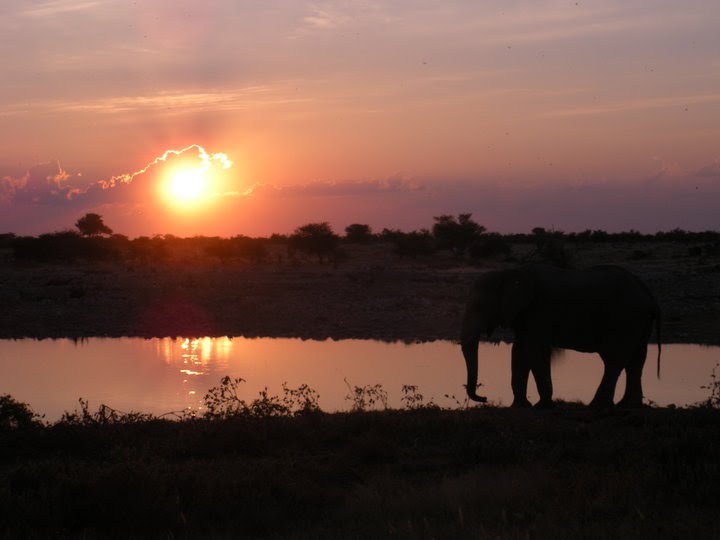
Doug and I are picking our friend Karam up from the airport tomorrow and then off to Etosha Game Park for several days before heading up to our rural living quarters in Caprivi.  We'll be up in Caprivi travelling with Karam and getting to see Doug's work with EE in the Caprivi and then I'll be back in Windhoek at the end of the month to finish up work at the Poly.  Lots of adventures in front of us before we return in June!

I look forward to sending updates.

Wow, a photo with both of us!  Our friends took this up at lovely lodge up above Windhoek where went the other night for a "Sundowner" (aka happy hour with a view).

Saturday, April 30, 2011

Early Alert Pilot at the Poly

Work at the Poly is humming along but will be interrupted this weekend by a three day holiday next week.  The students have been on two-week break but staff and faculty have been here helping to run “vacation school” which is when the distance learners come to campus for 1:1 time with the faculty.  Doug and I are in town this weekend and rest of week and then our friend Karam arrives from the US and will stay with us for two weeks.
Things are looking hopeful that I will be able to set up a “pilot” early earning system before I leave in June.  The program will involved three schools—Health and Applied Science, Communications and the Engineering Bridge Program (which is similar to remediation courses to prepare students for Engineering degree).  Each school will (hopefully) hire an academic advisor that will follow up with electronic referrals from the faculty.  These referrals will occur around the 7th or 8th week of class and then academic advisors will follow up with students and connect them to the appropriate resources on campus.  While by no means the complexity or depth or UC Denver’s EA program—I am hoping that this can make a meaningful and significant difference for struggling learners here.   And if the individual schools take real ownership of this issue—I think they will work to sustain and grow the concept.
Some continuing challenges:
·         Reluctance by Deans to hire someone from outside the university—I want to hire a completely new person and they continue to push to hire a current faculty member and reduce their teaching load.  I continue to push for an academic support staff, not a faculty member.
·         Resources—many of the places that academic advisor might look to send students to are resource challenged—e.g. Writing Center does not appear to have the capacity or ability to serve large number of students.
·         Pilot—while I’d like to see a longer pilot, they only appear willing to give it one semester before they decide if it is working. 
·         Politics—imagine that.  It’s also interesting to navigate challenges of different schools, center, departments, and individuals as I try to make these changes. 
Why I remain optimistic:
·         Everyone I have spoken to from faculty to the registrar see this as having great potential to make a real difference for struggling students
·         They want to implement quickly –often times in Namibia people are great about making a “plan” and not so great about implementing.  They are pushing for such a quick start b/c they don’t want to put all my work on shelf and watch it collect dust after I leave
·         I have met several key faculty who really seem to be committed to access to higher education for more Namibian students

Holy Shit! These Dunes and NaDeet are Awesome

Please excuse my French. If you watch TV in Namibia all types of profanity (including saying “jesus” or “God” ) are cut out.  But don’t you worry—the youth of Namibia are picking up a few good sayings here and there.  As we went to sleep on Sunday night at NaDeet environmental education center, we heard the kids who were in the tent next to us telling each other “Holy shit” and “What the hell”—aw, makes me feel like I’m back home.
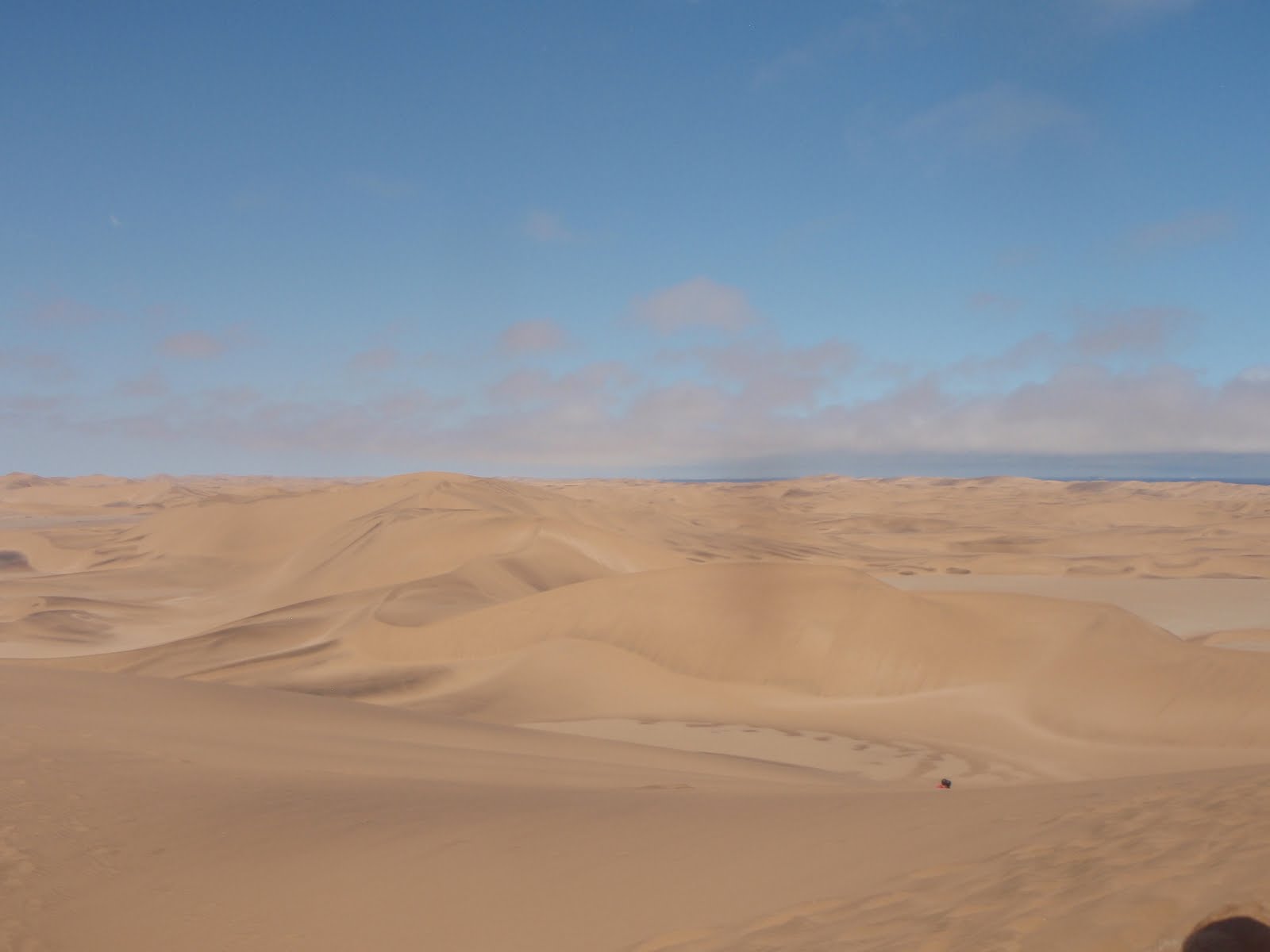
But back up a bit—we arrived on Sunday morning at Sossusvlei—these are the largest sand dunes in the world and they are incredible.  While I do love the beauty of the Dunes outside of Alamosa—these dunes make those look like a mini-toy version.  And to make it even more incredible they have received an incredible amount of rain this year so the pans (which are typically dry water beds) had some water in them (this really only happens like every 25 years),  and the base of the dunes were also covered with bright yellow flowers.  The colors and landscape are incredible.
Doug and I hiked to the top of the largest dune –which took about an hour—and then we ran all the way down to the famous Deadvlei pan.  While we thought the run down would actually be fun, but the sand was SO HOT that we actually had to stop many times and push ourselves down on our bums.  The Deadvlei pan actually has some very famous petrified camelthorn trees which are completely eery!  Here are some photos.
 The view driving in...
 OMG it's dry out here!
 Water in one of the pans--this is very, very rare.
 Running down from the top of one of the dunes--hot feet.
 Ancient little forest of petrified camelthorn trees--eery.
After spending the bulk of the day at Sossusvlei, Doug and I drove about 100KM through the NamibRand (this is a collection of  private land that is marked for conservation –similar to Nature Conservation efforts in US) and found our way to NaDeet (Namibian Desert Environment Education Trust).  NaDeet was located about 11KM off the (already gravel) road.  The LONGEST 11KM of our life.  We were assured by Viktoria—the Director—that  the road was passable by 2WD.  I guess we have slightly skewed versions of what is “passable”—we drove through deep sand, huge rock beds and over large sand humps.  I was sure we weren’t  going to make it and would have to walk the final KM’s to get to the center for help.  Finally, arriving at NaDeet at sunset—Doug and I thought we’d have to live here forever.  Granted, it was a beautiful place to live forever—we realized that no other cars at the center were 2WD.  Note to others who go to NaDeet—don’t attempt with 2WD.
We spent the next two days at NaDeet with a group of students from Windhoek.  NaDeet was created in 1998 by an American (who has since married and become a Namibian) to teach kids about sustainable living practices.   Check out their website at http://www.nadeet.org/.
This place is amazing.  Kids  are never turned away b/c of their ability to pay-and basically for less than $100 American dollars they come to “camp” for six days to learn about climate change, air pollution, deforestation, biodiversity, etc.  Kids monitor their water and electricity consumption and the entire place is solar powered.  They take bucket showers, use composting toilets and sleep in recycled A-frame tent-houses.  In addition to learning, the kids and the staff cook with solar cookers, energy efficient stoves and solar ovens.  They prepare all meals with these tools.  They go on dune walks, learn about local plant and animal life and just have a whole lot of fun.  Doug is hoping that he and NaDeet can work together in the future so that when the kids return to their towns there are actually places where they can purchase the technologies they learned about at camp.
NaDeet Base Camp--can't figure out how to rotate this photo

 View at sunset from the base camp
 Students from Windhoek learning about solar cooking--they are in grade 6 so about 12 years old.
Karly--Peace Corps volunteer here teaching kids about how the solar panels provide energy/electricity to the learning center.

We left on Tuesday morning and drove the harrowing 11KM back out—Doug seemed to think the road was easier on the way out.  I was not convinced.  I said many prayers to the little baby Jesus and I think that did the trick.  We arrived back to Windhoek on Tuesday evening—and committed that the next time we visited the Dunes and NaDeet we will opt for a car with more clearance.


May Budget Rent a Car feel lucky this made it back in one piece.
Bill Withers Rolling in His Grave

I’m not sure quite why but Namibians love to play copycat versions of songs—these are mostly big US hits but re-mastered by UK  or Africaan artists.  And let me just say for the record—they are AWFUL. Doug mentioned the other day that he had never heard a Springsteen song sung with such little soul.  Agreed. 
Last Saturday Doug and I took off in our trusty 2WD rental for the desert.  We planned to drive the first day over a mountain pass and spend the night in a placed called Solitaire before heading to the most famous tourist attraction in Namibia—the largest sand dunes in the world—Sossusvlei.   We headed   off on a random road outside of Windhoek which was only on paved road for about 10 miles before it turned to gravel (fairly standard here).  Along we drove through rolling landscape for about 150 or so miles—we began to come across puddles of water and I was nominated to get out, walk through to check for depth and give the thumbs up.  About 5 puddles in, we ran into a tourist group (in a large, SUV).  The guides’ exact words, “If you try to go up this path, you will DESTROY your car.”  This was the first of two large SUV’s that came from the other direction and stopped to warn us—so we decided to take their word for it and turn around.
We then tried to take several different roads but each time realized that we simply weren’t going to make it in our little squirt mobile.  So, all the way back we drove to Windhoek and down the paved B1. Five hours later, we were in a real good mood.
Around sunset we pulled into Hardap Dam—Doug suggested it was the Lake Tahoe of Namibia, I would suggest something more along the lines of the Pueblo Reservoir.  We pulled into one of two campsites in this 1970’s esque rest camp and settled in for the evening.  The view of the damn was lovely.  The company, not so much.  Think of the reservoir crowds on holiday weekends—lots of boats, beers and barbecue.  Around midnight (hours and hours after we’d been asleep) the campsite next to us began their karaoke hour.  And karaoke hour consisted of only one song—Lean on Me—and not by Bill Withers.  Lean on Me with synthetic beats and a back up choir, over and over and over again.  I tossed and turned and weighed the options…not a lot of guns in Namibia—if I go over and threaten them, they probably won’t have a gun.   Only the fact that I knew my Mom would disapprove kept me from rolling out of my tent to kick some ass and take names.
5AM rolled around and Doug and I got up early to make it to the Dunes  at a decent  hour.  If I ever hear that tune again, I will hurt somebody.

Next day we saw the mountains we couldn't get over in our 2WD from the other side.

Friday, April 22, 2011

Doug Vilsack Ain't No Greg Mortenson: Elephant Energy's Work in Namibia

All--

Many of you have asked about Doug's work here in Namibia so I thought I'd take a minute to  make a shameless plug for EE's Global Giving campaign


Doug has been here since February and since he arrived EE has expanded their solar-powered light distribution network to nine rural shops in the Caprivi Region and are growing rapidly.  What started as one shop in the market has become nine and is providing local Namibians with a small-business opportunity in addition to the distribution of the small-scale solar technologies.   If you are interested in reading more about our work in Namibia you can check out our two-pager about the Energy Shops Project here: http://www.elephantenergy.org/uploads/EE_Fact_Sheet__April_2011_.pdf
 And, this weekend we'll head to NaDeet (an environmental education camp) where we're going to look at the capacity to bring the Solar Schools Project to life. 

I know many of you have purchased solar lights or made a donation to EE before, and I'm hoping that you'll support the work again. I would love to have any and all friends who read this blog  donate $20 (or more) via the Global Giving page so we can raise the last $3,400 we need to close out this project by the end of April:

http://www.globalgiving.org/projects/promote-renewable-energy-shops-in-rural-namibia/


In addition, Doug has created a Women's Project which you can read about here:http://www.elephantenergy.org/uploads/WE_Project_-_Rural_Women_s_Energy_Article__Final_.pdf

We're off to the desert tomorrow!  Happy (belated) Passover and Happy Easter weekend to all.

Tuesday, April 19, 2011

Retention at the Poly

My work at the Poly is becoming more defined each week.  Last week I sat in on many different first year classes and also met with the Offices of Student Life and the Center for Teaching and Learning.  During my time here,  I am going to help conceptualize three different retention strategies that will be instituted as pilot projects in the School of Communications and the School of Health and Applied Sciences (similar to a US school of Public Health with some other applied degrees --EMT, etc. thrown into the mix).  The system here is very de-centralized and each school acts on it's own.  These two schools both indicated that their faculty would committ to working on retention issues. The three ideas I am going to help them consider are an early alert system for students who are struggling in first-year courses (this will be my primary focus), the concept of a first year seminar to help the disconnect in the very large first-year courses, and the idea of a summer reading or first lecture series during orientation to help add an academic componenent that is also a small-group activitiy.  Last week I wrote several colleagues about how UC Denver and other institutions built their early alert program.  Thought folks would enjoy seeing the challenges/opportunities here at the university.  All in all, I've got my work cut out for me!

To offer some more insight about the retention challenges/differences
  • K-12 system is very poor here--even best students are good memorizers but not good structured thinkers/problem solvers.  They are coming from a poor K-12 system into a European/American university model.
  • Very large first-year courses.  All students are required to take a core that includes Basic computing, English, Mathematics, and some other core courses inside their school/major.  I've been to many of these classes this week and they have between 150-200 students.  How do faculty with such large classes know what students are and aren't doing well?
  • Heavily based exam system rather than continuous evaluation.  Especially for large classes, multiple choice tests are only way professors claim to be able to grade everything.  And they often weight the final exam VERY heavily (sometimes as much as 60%).  Also--once a student fails an exam, the class is not available unitl the next year (e.g. English 101 only offered in fall semester and not again until next fall). 
  • No advising system in place--students have to figure most out on their own.  Also--no such thing as an undeclared major--students are admitted directly into a school/college.  Admission process is that students score high enough on national tests and are then admitted to the university if their score is high enough. Small schools such as environmental health, journalism etc. only take about 30-50 students which is great for them, but 60% of student body is in the business school which some faculty label as the "throw away" degrees.  You can't get in to other degree programs, you are placed in Business administration or Human Resources degrees.  This makes it very hard to motivate students who wanted to be in the Communication school but are placed in Busines school instead.
  • Personal issues: financial: many students have enough money to pay for tuition but not much else--several students in class I attended didn't purchase the book b/c they had no funds, transportation: no transportation system and bulk of 12,000 students live off campus.  Some walk 5-7 miles each day to get here.  I asked about a bus from the neighborhood where most live and they said they've tried that and the system was abused (not sure what that means).  And of course the usual college issues: drinking, dating, etc.
  • Academic issues: English is official language of the university and the 3rd language of most students who come here.  Biggest academic need is english writing skills.  Problem solving/structured thinking is next--students can memorize but not problem solve. General study skillls: students take 6 courses per semester which are each 4 hours (or 4 days) per week.  These students are in class ALL DAY LONG.  Many have no idea how to juggle their schedule, study time etc.
  • Self esteem--Namibian students are very polite but extremely timid.  Very few would have any sense of how to advocate for themselves here at the University.   They have workshops here on self-esteem but I think the larger issue is how to students begin to advocate for what they need.

Some opportunities:
  • They do have a writing center and a Center for Teaching and Learning which does some professional development with faculty but sounds like it is fairly limited.  Essentially our version of Student success center, faculty professional development and K-12 outreach work all happen at the CTL.  Writing Center has potential but capacity is a big issue.  I have suggested using senior English/communications students to pay as tutors but they said that there schedules are so heavy that they don't have time to tutor. 
  • Both School of Communications and School of Public Health faculty seem eager and willing to participate in such a system.  These two schools are doing more continuous evaluation rather than just exams than some other colleges which might make a 5 week check-in easier than a professor that won't have a test until mid-semester
  • Students are highly motivated and hard workers--if they've made it here they are part of a very small percentage of students in this country who go to college (only 2 universities exist).  The sense of entitlement to a college education does not exist here.
  • While faculty don't have a very diverse teaching style--mostly just lecture in delivery--those who I have observed are very good public lecturers
  • Office of Student Life has capacity in terms of a social worker, health office (nurse), and counselor
  • The Office of Student Life has done this type of "check-in" on their student leaders (student council etc.)--getting their grades half way through semester and offering help if they are struggling--they like the idea of providing this for everyone, not just their star students.
  • Willingness on behalf of administration to build academic advisors into the schools infrastructure
  • Willingess on behalf of administration to also take reccomendations under consideration about what is necessary to make such a model successful

Sunday, April 17, 2011

Swakopmund photos

 It should be illegal to be this cute
 That's about a gazillion seals jumping into the ocean

Dunes in Swako